Extracorporeal
Shock wave Therapy ( ESWT)
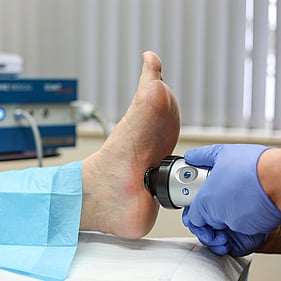
Clinical use of Extracorporeal shock wave therapy (ESWT) was first introduced into practice in 1982 for urologic conditions. The success of this technology for the treatment of urinary stones quickly made it a first-line choice for the non-invasive, effective treatment of other conditions including but not limited to; heel pain, Achilles tendonitis, Plantar Fasciitis and ankle pain.
ESWT is an intervention that stimulates the body’s natural healing process. Additionally, SWT has been shown to have a direct effect on local nerve endings resulting in a decrease in pain.
Signs & Symptoms
ESWT, Focal “true” Shock Wave therapy can be an effective treatment for clinical signs and symptoms associated with conditions that include:
Heel pain
Plantar fasciitis / Heel pain
Painful heel spur formations
Recurrent ankle pain
Pathological bony cartilaginous tissue formation
Painful scar tissue formation
Achilles tendonitis
Diagnosis
The type of ESWT that is best suited for a particular patient is determined after consultation.
It is also important to understand the difference between low energy (Radial pressure wave, or Pulse wave) and “true” high energy (Focal shock wave) therapy when considering whether you are an appropriate candidate for treatment and which type of approach is most likely to yield positive results in the treatment of your condition.
Treatment
The Foot Place is proud to be able to offer “true” high energy, Focal shock wave therapy and low energy Radial pressure/pulse wave therapy.
Focal shock wave therapy can offer relief for conditions that include:
Heel pain
Plantar fasciitis / Heel pain
Painful heel spur formations
Recurrent ankle pain
Pathological bony cartilaginous tissue formation
Painful scar tissue formation
Achilles tendonitis
Due to the reduced cost of low-energy Radial pressure wave or Pulse wave machines, many patients may have the impression that they have received “true” (Focal) shockwave therapy. Unfortunately, after questioning, it is often found that they have received the jack hammer type treatment that doesn’t produce a shock wave. In certain cases, there are differences in the effectiveness of high-energy shock wave vs. low-energy pressure/pulse wave therapy.
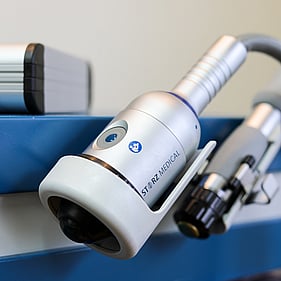
We use advanced ESWT technology designed and manufactured by Storz Medical, Germany. Storz Medical designs and produces gold-standard medical instrumentation.
Focal shock wave therapy
High energy ESWT (Focal shock wave therapy) or “true” shockwaves are classified as short duration (approx. 10msec) high energy pulses (5-100MPa) that break the sound barrier resulting in a shockwave. Our high-energy shockwave technology allows the shockwave to be focused directly through the affected tissue, resulting in several effects:
Mechanical pressure and tension forces on the tissue have been shown to increase cell membrane permeability, thereby increasing microscopic circulation and therefore the metabolism within the treated area. This promotes healing and may result in the dissolution of calcific deposits.
The pressure front creates a “cavitation bubble” which are small empty cavities created behind this pressure front. When the bubbles collapse, they create a resultant force that has a mechanical impact on the treated tissue. This force helps to break down calcific deposits embedded in damaged tissue.
Shockwaves stimulate osteoblasts which are cells responsible for bone healing and new bone production.
Shockwaves stimulate fibroblasts which are cells responsible for the healing of connective tissue such as tendons.
Diminishes pain by two mechanisms:
Hyper-stimulation anaesthesia – local nerve endings are overwhelmed with so many stimuli that their activity diminishes resulting in a short-term reduction in pain.
Gate-control mechanism – whereby local nerves are stimulated to recalibrate perception of pain and result in a longer-term reduction in pain.
There are three different mechanisms for generating high-energy shock waves resulting in three different types of SWT devices:
Electromagnetic shockwave (Sonocur and Dornier Epos machines)
Piezoelectric shockwave (Piezoson)
Electrohydraulic shockwave (I.E. HMT OssaTron machine)
Radial pressure wave (Pulsewave) therapy
Low-energy shockwaves are generated by a radial pressure wave or pulse wave hand-piece that feels like a vibration “jackhammer” sensation.
This type of shockwave is more accurately described as a pressure wave and differs from “true” shockwave technology in the following ways:
Low energy pressure/pulse waves travel at a much slower speed and don’t break the sound barrier hence a “true” shockwave is not produced.
Low energy pressure / Pulse waves are longer, slower and less intense.
Radial pressure waves/ Pulse waves diverge from the source, unlike high-energy shockwaves that converge on a target, resulting in less energy applied to the tissue with low-energy PWT vs. high-energy SWT.
This type of treatment can be useful for the treatment of tightened muscles but is less effective in treating scar tissue, bony cartilaginous tissue, heel pain, heel spur formations, plantar fasciitis/heel pain and Achilles tendonitis in comparison the “true” high energy Focal Shock wave.
Compliance with treatment and rehabilitation recommendations are important factors in achieving optimal results.
The type of ESWT that is best suited for a particular patient is determined after consultation.