Mallet Toes
A Mallet toe is a deformity that causes the end of your toe to buckle, bending downward instead of pointing forward. We only become involved in their treatment when the toe position produces pain, infection or irritation within footwear. Women are more likely to get pain associated with mallet toes than men because of footwear.
Signs & Symptoms
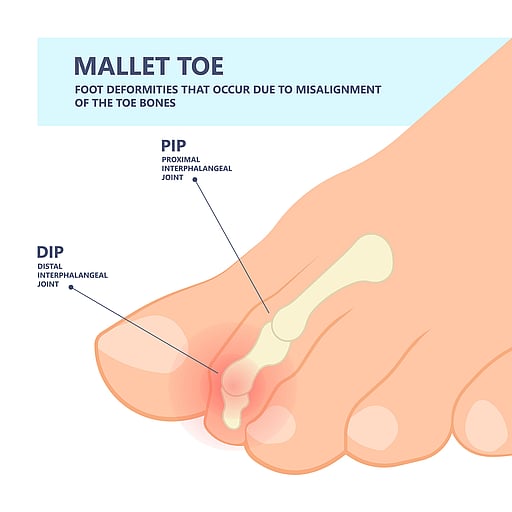
In a Mallet toe, the joint at the end of the toe buckles, pointing forwards towards the ground instead of a normal neutral position, facing forwards.
The tip of the toe turned down, often pushes hard against the bottom or end of a shoe, causing pressure and discomfort. In some cases, a bursa (rather like a deep blister) is formed over the joint and this can become inflamed (bursitis). With time, hard skin (callus) or corns (condensed areas of callous) can form over the joints or at the tip of the toe.
Over time the nail toe can also become damaged and thickened. This can add pressure to the tip of the toe, increasing irritation, discomfort or pain at the area.
Common symptoms can include:
Deformity/prominence of toe
Pain
Redness around the joints
Swelling around the joints
Corn / Callus
Difficulty in shoes
Difficulty in walking
Stiffness in the joints of the toe
Causes
A Mallet toe occurs when the joint at the end of the toe cannot straighten, when the toes become bent at the distal (second) interphalangeal joint, making the toe prominent. This can affect any of the three central toes, however because the second toe is typically the longest, it is the most likely to be affected by mallet toe.
There are many different causes but commonly it is due to shoes or the way in which the foot works (functions) during walking. If the foot is too mobile and/or the tendons that control the toe movement are over active, this causes increased pull on the toes which may result in deformity. Over time, this pulling (contracting) of the toe can cause the muscles that control the extension of the end of the toes (upwards movement ) to weaken, allowing the opposing, strong flexor muscles over-power and buckle the joint at the end of the toe. Over time these powerful long toe flexor muscles hold the toe in this position creating the “deforming force” that produces a Mallet toe shape.
Diagnosis
The correction of any foot disorder is dependent on the provider understanding the cause of that disorder.
Our specialist podiatrist, Stefan, is highly qualified and experienced with over 30 years of clinical practice. His knowledge and experience enables him to offer a thorough, in-depth assessment of your condition. This may include but is not limited to an examination to help determine the severity of your toe deformity.
Specialist examination to determine whether your toe is flexible, semi rigid (semi-reducible) or rigid (non-reducible) will be undertaken. A thorough in-depth examination is undertaken to help determine the cause of the Mallet toe.
A biomechanical assessment and gait analysis can be used. If your Mallet toe is related to the way in which your foot moves when you walk or stand (a biomechanical abnormality) the use of prescription orthotics and change of footwear may be recommended.
If the circulation at your toe is questionable, a colour doppler ultrasound can be used to assess blood flow.
Sometimes low dose digital X-ray, low dose fluoroscopy, can help rule out any bony/cartilaginous abnormalities that may be compounding the condition. In some cases haematological tests or a referral to MRI may be required.
Once a diagnosis is determined; he will spend time to fully explain your condition, providing treatment options aimed at providing you with a long-term pain relief for your specific condition.
Treatment
The treatment of a Mallet toe depends upon the severity of the condition. This can be related to the progression of the Mallet toe, if it’s flexible, semi rigid (semi-reducible) or rigid (non-reducible).
A thorough in-depth examination is undertaken to help determine the cause of the mallet toe. When it’s related to the way in which your foot moves when you walk or stand (a biomechanical abnormality) the use of prescription orthotics and change of footwear may be recommended.
Treatment may include recommendations of a regime of specific, targeted mobilisation / stretching techniques that you can do at home. Over time, these can help straighten the toe and reduce its rubbing within footwear.
Sometimes a custom made device can be made to help deflect pressure away from the toe, providing pain relief within foot wear.
Early treatment for a painful or irritating toe is recommended. This helps to reduce the damage this condition can do to your toe and help you maintain a pain free, healthy and happy quality of life.
Prevention
Early treatment for a painful or irritating Mallet toe is recommended. This helps to reduce other injury that is commonly associated with this condition to help you maintain a pain free, healthy and happy quality of life.
Mallet toes can be caused by tight-fitting footwear. Tight-fitting hosiery, in-particular tight fitting “onesies” for infants can also harm the growing foot and cause toe deformities. It’s best to cut young feet free and cover them in cosy, loose-fitting clothing. Other toe shapes are inherited and there is little we can do to influence their shape. In general, give your toes room to breathe, treat them like fingers rather than sausages and do your best to accommodate their shape rather than force them into spaces that are too tight.
Any exercise aimed at improving your general flexibility is also highly recommended. This includes but is not limited to:
Pilates
Yoga
Tai chi
Regular deep tissue / sports massage
Acupuncture
Regular osteopathic treatment
Regular chiropractic treatment
Regular physiotherapy
Prevention is better than cure. If you have any questions, please contact our rooms and we will do our best to help.